jeudi 23 avril 2009
Kaboul en état de siège
dimanche 8 mars 2009
Le premier ministre zimbabwéen victime d'un accident de voiture
samedi 14 février 2009
G7 , no financial protectionism
- Praise for recent economic moves by China;
- Help for banks; and
- The need for a speedy end to the Doha talks on world trade
This meeting is seen as "a stepping stone" for a next meeting in London in April of G20.
This article isn't really precise about the decisions taken by G7. Another article on Le Monde isn't very precise, neither, although it gives further information. Does that mean that G7 didn't manage to really take decisions about the global economic crisis ?
However, one thing is clear; the "era" where the economic system should change and that liberalism should let the place to another kind of economic system and concept hasn't come yet. Indeed, after the economic crisis, it has been heard a lot that the economic system would change and that the crisis was a good lesson for liberalism. People thought that another economic system would be put instead of liberalism. The conclusion to avoid protectionism made by G7 contradicts this idea. I don't know if raising barriers to free trade would worsen the situation because every country would become withdrawn, or if it could help the situation by avoiding such dependence between all the countries. Analysts in G7 seem to believe that barriers would worsen the downturn.
And you, what do you think ?
dimanche 18 janvier 2009
Chanel fait face à la crise .
La maison de Haute-Couture du 31, rue Cambon fait désormais face à la crise financière mondiale, mais assure qu'elle ne remet pas en cause ses projets.
dimanche 7 décembre 2008
Le début d'une crise Mexicaine.
La crise financière qui a débuté aux Etats-Unis affecte désormais leur voisin, le Mexique. En effet, la hausse du chômage américain touche de nombreux immigrés mexicains, qui se voient alors contraints de retourner dans leur pays.
samedi 6 décembre 2008
UK, after banks' rescue, mortgage defaulters
People who are not able to pay their mortgage, because they've lost their jobs or because of a drop of income, could defer their interest payments for up to 2 years.
"The sum forgone by the banks would be added to the mortgage and have to be repaid when the holder's circumstances improved."
If people can't pay their interests after this time, the government would pay the interest deferred.
This plan will concern customers of HBOS, Abey, Natiowide,Lloyds TSB, Northern Rock, Barcklays, Royal Bank of Scotland and HSBC.
Gordon Brown also said that Northern Rock and Bradford and Bingley would delay the repossession, which is "a standard practice anyway".
This plan seems to be a response to people's critics about rescuing plans. People, through government help, were paying the institutions who were the causes of the crisis. Now, people who were " victims of the system" are helped too. This would take a weight away of some customers shoulders, although, if they have more time to pay, they will have more interest to pay too. Opinions seem to be split over this policy : some people don't want to pay, after the banks, for people that "put themselves into debts", and some other are quiet happy with that, such as the Liberal Democrat party, who's saying that he proposed this policy months ago.
But what called my attention is that, as for the nationalisation of a few banks in Great Britain, this policy is state interventionism. According to what I know, the UK wasn't very 'used' to such interventionism. I think that this event, amid other similar ones, shows that a new economic system is slowly coming, or at least that changes in policy are taken. However, I think that in order to manage this change, people's minds and views have to change too, and this is more difficult and long than an economic restructure.
dimanche 30 novembre 2008
The Middle-East's changes of objectives.
This article shows us that finally, and on the contrary of some economists predictions at the beginning of it, the crisis is not only an Occidental one, but a global one. Indeed, after China's, the Middle-East countries' problems prove once again the dependance of the others financial powers of the world to Occident (specially to the USA), and maybe show the end of the actual globalization, and the beginning of a new one, more controlled and more nationalist.
mercredi 19 novembre 2008
le sauvetage d'Opel

L'industrie automobile est en danger ...
Après la chute de l'industrie automobile aux États-Unis evoqué par Thibaud avec la possible fusion de General Motors et Chrysler, le groupe General motors continu de mal se porter. Sa filaire Opel , a dû bénéficier d'une garantie allant jusqu'à 500 millions d'euros. Son "groupe mère" Général Motors lui demande une garantie d'un milliard de dollars pour se sauver de la faillite.
Cette demande de garantie a été faite au niveau du Land de Hesse, ou la principale usine d'Opel est placée, mais, le gouvernement d'Angela Merkel prevoit de s'y attarder aussi. Mais le gouvernement allemand veut que l'aide apportée ne bénéficie qu'au groupe allemand et non aussi à sa société mère. Cette réaction du gouvernement allemand montre bien qu'aujourd'hui, a cause de la crise, les sociétés et les gouvernements ne se font plus confiance.
Cette article nous montre que la crise est loin d'être finie et que le secteur automobile est en train de s'essoufler. Et cela est dû au fait que les consommateurs n'ayant plus un grand pouvoir d'achat, ne se tentent pas à acheter de nouvelles voitures. De plus, la flambée des pris du pétrole, a quelques peu refroidis les consommateurs. Certes, en se moment le baril est en dessous de la barre des 50 dollars, mais les gens ont envie de changer de façon de vivre. Ils s'intéressent de plus en plus au énergies renouvelables. Mais se n'est pas le seul facteur, le fait que les consommateurs achètent moins, il y a aussi le fait que les banques n'autorisent plus de crédits au entreprises, qui eux sont vitales aux entreprises technologiques. Ils leur permettent de se renouveler et d'innover.
dimanche 16 novembre 2008
Mondial press reactions about G20
The Observer : it's a good thing that big developed countries and emerging ones are discussing about a coordinate action about financial problems. If it's too vague it's mainly because they could not resolve in one day what has been done in one generation.
Spain: It's a first step but the principles are too generals about reforms and actions.
France/America : no editorial about it
Italy : they ask if the cordinate relaunch is sincere and they are seeing very well a "new oder" coming : the power of Europe, the old continent, would not be as strong as before on the international stage.
India : Everything's quite good. New Delhi influence on the international stage is growing and they're hoping to be protected from the protectionism od developed countries.
Brazil : they see the proposal made by their leader as a very good thing : G8 becomes G20
Japan : they are anxious that Tokio would be isolated because it wouldn't have enough margins to act in order to participate to the relaunch actions.
We can see that the conclusions of the G20 rise many different opinions which, however, agree on one point : they ar etoo vague, there is no concrete plans. Well, I think that it would come but it would be hard because, as we can see it from the international press, all the countries are trying to keep their own interests and to be "winner" of these new plans to restructure the economy. Everybody would need to make concessions. I think that te G20 is a good symbole as the election of Mr Obama was, of "open minding". some emerging countries are heard. The world changes. This could be linked with the "swap of power" from the West countries to the East countries, or from the rich countries to the porr ones, as it's thought by Italy, according to its press.
To come back to the G20 and its conclusions, before it I heard politics and economists on radio saying that there won't be some miracle from this meeting. The same kind of point of view expressed by The Observer. I'm wondering if this kind of no expactation set up before the meeting had an influence on the conclusions of it, or if on the contrary because people were not hoping so much about this meeting they are happy that a first step has been taken.
dimanche 19 octobre 2008
The breakdown of the Giants
dimanche 5 octobre 2008
The end of the Benelux Bank.
Belgium and Luxembourg are looking for an investor, who can buy the remaining activities of the Bank Fortis , after the decision of Netherlands to nationalize the dutch part of the financial group.
The plan programmed the last week-end planned the resale of the participation of Fortis in the dutch bank ABN Amro (bought in 2007 for 24.4 Billions Euro) to ING, which finally decided to stop negotiations. That's why the Dutch government has decided to nationalize all the activities of Fortis in Holland ( notably the essential of the activities of ABN Amro ) for 16.8 billions Euro. This nationalization leads to a disassembly of the group.
Belgium has said that the only solution of the group is to sell itself to a private investor , or to nationalize it to protect all savers and to avoid the layoff of some of the 45.000 employers.
This “second saving plan” (the first one was the participation of the Benelux in the bank, decided in the middle of September but useless because of the panic of all the clients of the bank who withdraw a lot of money) is organized during the meeting of the “G4” in Paris (France, Germany, Italy and England) where these four members states tried to find a common position towards the financial crisis.
The Belgium Minister of Economy, Jeannot Krecke, has indicated that the French bank BNP Paribas could be a potential buyer . “BNP Paribas is a possibility among others” said Krecke.
Fortis has been the first bank in Euro zone to fall because of the subprimes crisis. She bought ABN Amro last year for 24.4 billions Euro just before the beginning of the crisis, which leads to a crisis of credits, which make the possibility to borrow money more difficult to finance the operation.
The project of disassembly of this transborder group, just after the plan of the Benelux to save it, proves that the crisis is now completely present in Europe and can be very dramatic without the intervention of all the governments. After a period of privatizations, we can see a period of nationalizations (even in USA, the liberal state).
However, even if this crisis is bad for all financial sectors (less benefits, less power...) , some banks profit of the fall of others to take more power, to grow in Europe or in the world (like HSBC, BNP Paribas or Barclay's).
dimanche 21 septembre 2008
After the rain, the sun
dimanche 14 septembre 2008
Blog post instructions (a reminder)
- Give your blog post a title (in the box entitled 'Titre'). Avoid re-copying the title of the actual article!
- Paste a link to your newspaper/magazine article in the box at the top entitled 'Lien'.
- Choose one (or more) of the SES notions from the list I sent you via email. Enter this SES notion as a libellé for your blog post in the 'Libellé' box down at the bottom. These should now also appear under the heading 'Libellés' in the blog sidebar.
- Try and devote your first paragraph (15-20 lines) to a resumé of the article and your second paragraph (again 15-20 lines) to commentary on the link between your article and the SES notion(s) chosen. How is the article interesting from an economic, sociological or political point of view?
- Preview your blog post before you publish it to make sure there are no errors (using the 'aperçu' button in the top right hand corner).
- If you have any problems, send me an email!
- Make sure your blog post is published before Sunday afternoon (17h) so that I can check it before Monday morning!
Britain 'to fall into recession'
Eurozone is going into recession in 2008 because of the high prices of food and fuel prices as well as the credit crunch (+ructions on the market) : slowdown in export and consumer spending.
UK, Germany and Spain are the most concerned, according to the European Comission forecast. It's the first decline of the block since its creation. According to a Treasury spokesman UK could well deal with these challenges (thanks to a high level of employment, low interest rates and rising incomes + many job creations).
The financial crisis in America had repercussions in Europe because of our tight links (especially the UK) in economy. This can have many consequences on the economic growth and so, on the citizens'lives themselves. Indeed, if the economic growth goes down, then, that means that the country or area is less rich and so people's lives are less confortable than before. That means a lakes of confidence, so people buy less, therefore the demand is going down. It seems to be a circle (without being pessimistic) because to relaunch economy, the European Central Bank needs to put interest rates down, and so, demand will go up. But, with the inflation, they have to keep interest rates high to not make inflation more important. However, UK could well deal with the recession because it has good circumstances (high level of employment, low interest rates, rising incomes and many job creations) to make people produce and spend, this will relaunch economic growth.
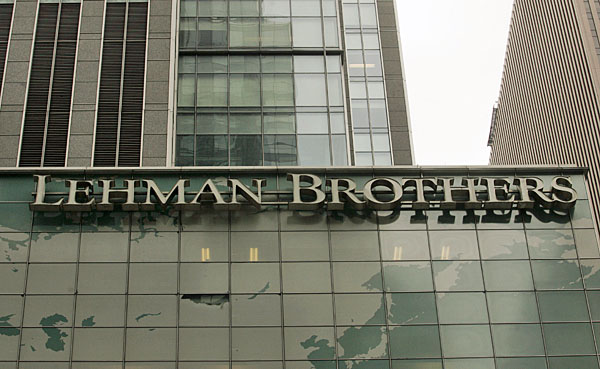
The fall of the 5th Wall Street 's Bank
The business bank, Lehman Brothers, still suffers the consequences of the "subprimes crisis" . The share has lost seventy five percent of its value in one week at Wall Street and continues to drop. The priority for Richard Fule (the CEO of the bank) is to forget his will to save the independance of the bank and to find a controlling stockholder.
According to the "Washington Post" and the "Wall Street Journal", the Central Bank conducts negociations with private investors, such as the second american bank , "Bank Of America", ( who is, according to the WSJ, "the white hope" of Lehman Brothers), or the english Barclays. Some hedge funds could be interested in , but this solution could disturb the Federel Reserve (according to the " New York Times").
When the Federal Reserve had organized the takeover of Bear Stearns by JPMorgan Chase, the Central Bank had accepted to finance the operation (30 billions dollars). The candidates of the takeover of Lehman Brothers would like to benefit of the same aid from authorities. However , those are not really willing to do it. Above all after the engagement to pay to safeguard the functioning of Fannie Mae and Freddie Mac ( 200 billions dollars) .
15th September 2008 : Finally, after the decision of the Barclays and the Bank Of America ( who has announced today his take over of the business bank Merryl Lynch for 50 billions dollars) to don't takeover Lehman Brothers, the 5th Wall Street's Bank becomes bankruptcy. Today , the world of finance is shell-shocked (CAC 40 : -3.78% , FSTE 100 : -3.92%, Dow Jones : -2.92%).